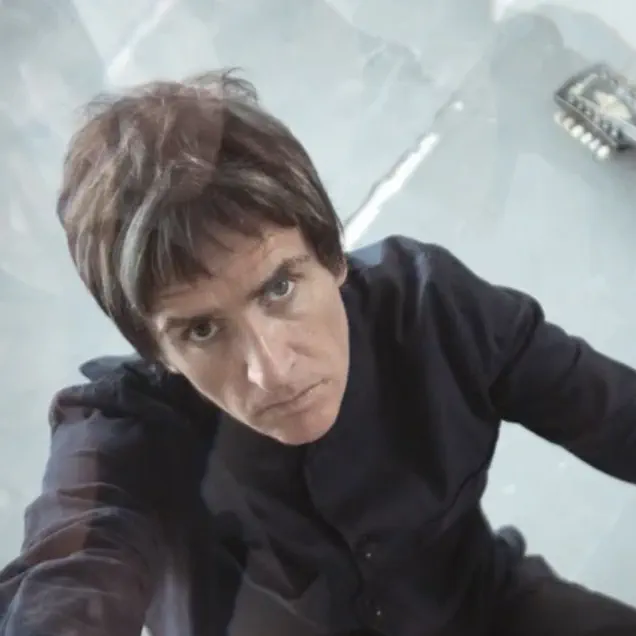
On a warm May night in 2026, the making of Johnny Marr’s fifth solo album came to completion with a final polish at a mastering session at Abbey Road. As he walked home through Northwest London at 1 am, something suddenly struck Marr about the record. “I felt that I’d said what I needed to say about the last couple of years of my life and how I see the world,” he tells Apple Music. “I didn’t realize going into it that I had so much to get off my chest.”
On The Age of Everything, that includes putting an arm around the shoulders of struggling souls (“How Come,” “That Feeling”), confronting rampant capitalism and prejudice with insurrectionary zeal (“It’s Time,” “Fire with Fire”) and paying tribute to a lost friend (“Beyond the Rain”). Naturally, it’s all rendered in kaleidoscopic guitar music, the bleaker moments often leavened by lifting melodies.
Marr road tested eight of the 10 songs on tour during late 2025 and early 2026, finessing hooks, tempos, and lyrics with each performance. It’s helped create one of his strongest solo albums. “It was my intention to do what I’ve been doing over all the other records but do it even more so,” he says. “A friend of mine described the record as ‘emphatic,’ and I quite like that.”
It’s also the product of a songwriter who, despite his unimpeachable status as one of British pop’s most influential artists, is always striving for progress. “I want to have goals and feel like I’m getting better and better all the time, and doing something different,” he says. “I don’t feel like the finished article and I hope I never do.” Read on as he takes us through The Age of Everything, track by track.
“Spin”
“For the longest time, I was singing the verses too melodically, and there wasn’t enough contrast [with the chorus]. It’s quite a tricky thing for a songwriter, to be critical of something that’s really melodic. I had to keep going back and making the verse work better to set up the chorus. I made ‘Spin’ almost conversational. It’s something that I’m trying to get better at. I’ve worked with some amazing melodicists—Neil Finn and Neil Tennant for example—and I’ve seen how they continue to learn and hone their craft. It’s an ongoing thing, which is one of the many great things about being a songwriter—you can just keep getting better and better.”
“Beyond the Rain”
“There’s a yearning quality in the music, that’s what gave me the title. The idea of sunshine after the rain. [In the verses] I’m trying to be optimistic and say there’s a better place, but I feel awkward saying it [and then] the chorus is a little like the sun coming out. We were about to record it, everyone was feeling good, and the phone went. It was Noel Gallagher, and he told me that [Primal Scream and Stone Roses bassist] Mani had died. We all knew Mani very well and I wondered whether we should down tools—as a sign of respect or just because it was difficult—but I could imagine him saying, ‘Mr Marr, Mr Marr, don’t stop rocking.’ So we did a take and everyone was in shock. We did a second take and that was really difficult. So we downed tools, and I sang it the next day and changed a couple of lines, like ‘I shine like a northern son/Back to where I once belonged,’ decided to spell it s-o-n. The meaning of the song, about going to a better place, took on more resonance. It was very, very poignant.”
“It’s Time”
“I am aware that this song sounds like it could have been me at any time in the last 40 years. Sometimes over the years, I’ve come up with a riff or a backing track that had this same feeling, and I’ve put it to one side because it almost sounded too like ‘me.’ But if something’s got such a strong spirit and it’s so damn catchy, you’ve got to drop your baggage and finish the goddamn song. It’s defiant in its optimism and its idealism. The good thing about having a real good pop tune is if you throw in a little bit of subversion, you get more bang for your buck.”
“How Come”
“You hope to have at least one of these songs on every album, where they arrive fully formed while you play the guitar. I was walking around my house, in between phone calls, with the acoustic guitar on, and the words and music came together. When I started to sing that chorus, I imagined it had been, if not a choir, quite a few people singing it together, it had this sense of inclusivity. Immediately, my process was like, ‘Well, therefore, it’s not about me.’ I find it easier to write when it’s not about me. There was an empathetic or sympathetic tone to the chorus. It made me feel like I should be reaching out to someone. That got me thinking about the idea of a young person feeling bad about themselves because of some kind of digital communication, through social media or text. It’s putting your arm around someone.”
“Ophelia”
“I’ve been kicking that riff around for quite a long while. I liked that it sounded like it could have been on an Electronic record, and I wanted my vocals to not get in the way. If I was packing it full of words or melody, it would have crowded out the guitar. The singing had to sit on top. Once I had that direction, it was a matter of trying to trick my brain that I’d already written it, and I did that by driving around listening to the song. Sat in traffic over few days, I was humming it, trying to not impose my personality on the music too much. The word ‘Ophelia’ really went with the track. My mind went to somebody I know who’s quite an impressive, confounding woman. I just used someone in my life to hang it on.”
“That Feeling”
“It’s another one of these ‘don’t feel too bad’ songs, with someone in mind that perhaps isn’t treating themselves too well and is living with the consequences. You want to put your arm around them and say, ‘You’re not really as bad as you think you are. We’re all human, we’ve all done it.’ It could be someone who’s just paranoid and you’re trying to hear them out and be there for them.”
“In and Out of Love”
“It’s about a breakup. I’m trying to be as direct as possible without losing the poetic imagery. You hope that you put it in a way that lots of people can relate to. I don’t think I’ve mentioned another song in one of my own songs before. I made the decision about two o’clock in the morning when I was writing the lyrics in my flat in London to put in ‘Lou Reed and Perfect Days.’ I figured that it’s got to be some couple’s favorite song. Then ‘Was the satellite in her eyes?/All the mystery and games,’ that’s alluding to another track off [Reed’s] Transformer, ‘Satellite of Love.’ When you’re falling in love, you see all of this stuff in the other people’s eyes, and then when it turns to betrayal or disillusion or break up, you wonder whether that was all a game or not.”
“Just Once More”
“I’m thinking of someone sinister, without mentioning any specific name. ‘I saw someone/Smile a blown-up smile/Their line was crooked/For miles and miles.’ That could be one of a few people on the world stage. It’s about lack of accountability and the relentlessness of day after day of, ‘What are these fuckers gonna say next? What are they gonna do next?’ Oh, there you go: There’s a war declared. Oh, there’s tariffs declared. Oh, right, there’s blaming the immigrants.”
“Fire with Fire”
“Sometimes you get a tune like the chorus of ‘Fire with Fire’ and you live with it and you try to break out of it, but it just is what it is. I thought it was too direct, but when you get the whole record together you need some things to be less oblique. It might not be obvious to other people but it seems really obvious to me: ‘Fight fire with fire…There’s no mercy/Blazing up insurgency.’ Unfortunately, I have found myself on the other end of an unwelcome, unwanted conversation with someone who’s trying to convince me that their political views aren’t as dodgy as they actually are. I didn’t even want that kind of person, credo, or scenario living within my songs but you’ve got to stand for something, it’s all right.”
“All in a Life”
“I was half-asleep and heard the tune. I knew it was good enough to not just stick it on my phone and forget: I had to get up and get my laptop and interface and all that nonsense, to actually put it down against the beat. I stayed up till half six, quarter to seven in the morning then rode around on the train doing a bit of people-watching, trying to get this sense of the humdrum of the daytime, the mind-numbing effects of a capitalist world. At the end, Meredith Sheldon sings like a siren from the sea—as a sort of call, something you want to move towards. The outro really felt like nighttime. With the album starting with ‘Look alive, now everything’s coming,’ and ending with that siren call into the night, it felt like a journey.”