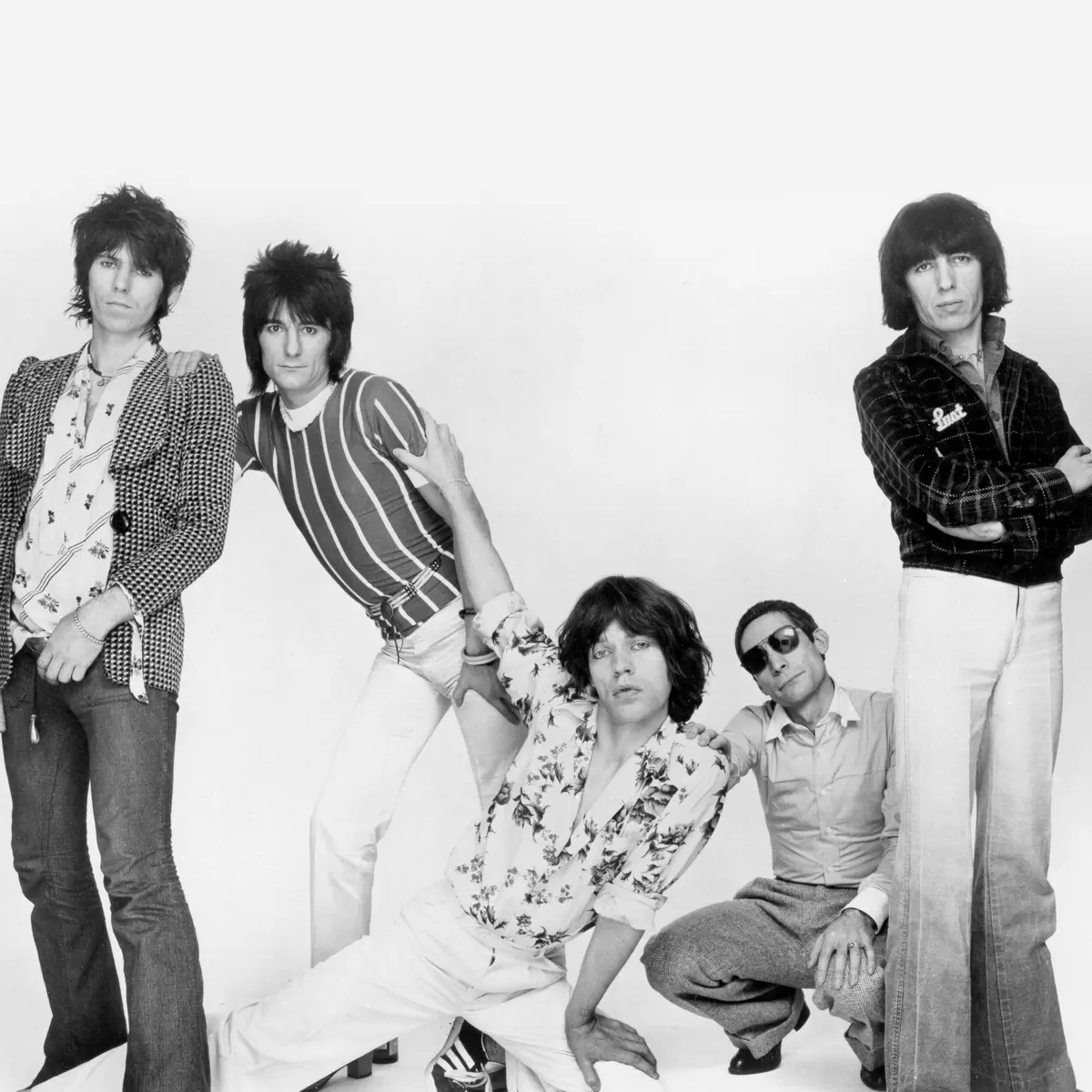
“We’re still raising the bar.” The Rolling Stones refuse to slow down on their 25th (and final? maybe?) album.
When The Rolling Stones went into the studio with producer Andrew Watt to record Hackney Diamonds—their 2023 album, and first batch of new material in nearly two decades—Mick Jagger was expecting it to be their final release. “I think you always think that: ‘This could be the last record,’” the legendary vocalist tells Apple Music.
Keith Richards and Ronnie Wood were less surprised when Foreign Tongues, their 25th studio album, came to fruition. “We did so much work on Hackney Diamonds that Andrew and I both looked at it as really a double album; we’ll just give it a year or two of a break,” explains Richards.
Foreign Tongues—which could, by Jagger’s logic, very well be the last Stones record—is every bit the companion to Hackney Diamonds as well as the playful, vibrant project Wood describes. This is a full-throated declaration of love for all the Stones hold dear: the blues, good ol’ fashioned rock ’n’ roll, and foundational pop melodies.
Their enthusiasm came, in part, from a rapid-fire writing process that enabled them to get their thoughts down quickly without picking them apart while recording. “We used to spend ages in the studio all night trying to make up songs that weren’t written,” says Jagger. “And so, we said, ‘We’re doing a bulldozer approach,’ so no one really has too much of a chance to take a song to pieces and say, ‘I don’t really like this. This could not be my cup of tea.’”
From snarling opener “Rough and Twisted” to the faithful cover of Amy Winehouse’s “You Know I’m No Good” and the moody “Covered in You” (which features Paul McCartney on bass), Foreign Tongues offers up the Stones’ favorite things on a platter, simply for the sake of their own enjoyment—exactly the kind of album you’d hope to hear from one of the best rock bands of all time in their golden years.
“The albums are getting more energetic, punchy, and we’re still raising the bar,” says Wood. “That’s the evolution of the band. It’s got that new youth and the new kick in it.”
Read on for insight from Jagger, Richards, and Wood as they take us through a few key Foreign Tongues tracks.
“Rough and Twisted”
Richards: “When we were listening to all the tracks, Mick and I sort of looked at each other, and I said, ‘That has to be the starter. That has a sort of character about it that says it all, and from there we can build on it and work on it.’ It’s got that Chicago blues feel on it, and Mick’s playing some great harp.”
“Jealous Lover”
Jagger: “All the falsettos I’ve used before have been mostly sweeter tunes and not so hard driving. I was singing falsetto, and I had [the pre-programmed beat] ‘hip-hop three’ on my drum machine. It’s a very simple drum machine. It’s like from the ’90s, and it just does only kind of groove beats; it doesn’t do rock. So, OK, hip-hop three, bang. Let’s start playing the piano to that.”
“Mr Charm”
Jagger: “The whole thing about all this music is the grooves have to be perfect. Each song has a groove that sways around—the drums and the bass have to work together, and the rhythm guitars have to work, and the vocals have to go with the drums perfectly. So, in a song like ‘Mr Charm,’ it’s almost like half semi-rap; it has to fit in with these hi-hat patterns. The guitars can slide over that, so they are in another place in the groove. Keith can just play—he made that really nice lick up, which I didn’t have in the demo. Then you put the vocal over that, and so then all of that makes that a groove, and ‘Mr Charm’ becomes a group song.
“Ringing Hollow”
Jagger: “You’re cheating the audience by making them think it’s about a woman, and then you realize by line four, or maybe later, that it’s not about women. It’s because you’re using the Statue of Liberty as a metaphor in the song as well. Keith liked this one straight away.”
Richards: “It’s a very tender sort of love song to America and what the fuck went wrong. I remember being in the ’50s, and I remember the jukebox and the cigarettes. The idea of having radio stations all across the board instead of just the BBC was, ‘I’ll die and go to heaven just to have that.’ There was so much we admired about America, and then, of course, close up there’s a few cracks in the bell. Might as well write about that, too.”
“Some of Us”
Richards: “That song has been hanging around in the head for years, and I never quite got around to putting the finger on it. Some songs are very elusive. I remember ‘Start Me Up’ was 10 years, from the writing of it to when it came out. I know it’s like good wine: Some of it’s better, you know, aged.”
“Covered in You”
Richards: “I’ve realized that Paul really misses being in a band. His joy of just being in that context is great. I’ve known Paul for, well, basically since The Beatles started, since we started, but only on the periphery. John and Paul did a couple of backup vocals for us—‘We Love You’ and ‘Dandelion’—way back in ’67 or something like that. He’s a lovely player, and I’d like to do more with him.”
Jagger: “I didn’t know he could play, like, punk style, the real simple stuff like we wanted him to play. He’s obviously got a lot of capacity to change gears.”
“Back in Your Life”
Wood: “I love that solo. That’s the last thing I did in the studio, and it was a nine-minute solo. Andrew Watt was in tears when I went into the control room. He had to cut it down to four or five minutes, but it took me over. I had no control over it.”
Jagger: “It’s a classic story of meeting a woman, and then you have a very quick fling with her, and then she ghosts you. I spent quite a lot of time getting that right, because in ballads you can’t get away with things—the shape of it has to be right, lyrically. The music has to be right, and then it has to have a build. You have to set the scene, all that, so that’s quite a lot of lyrical work. Singing it is quite a challenge as well because it starts tenderly and then you have to build it.”
“Side Effects”
Richards: “When I first started writing it, I realized that in America there’s ads for drugs on TV. Nowhere else in the world do you get this. The biggest thing that stands out in all these ads is side effects. So, I started it from there, you know, and I’m probably suffering from ’em now.”